
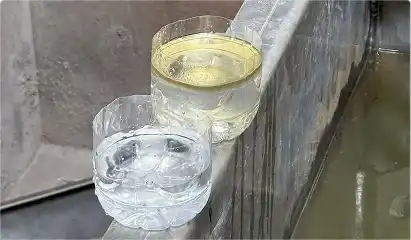
Not all oils behave the same in water, and understanding the differences is crucial for choosing the right separation technology. Oils in wastewater are generally categorized into four types:
- Free Oil – Larger droplets (>150 microns) that separate quickly under gravity. Almost any separator can remove free oil.
- Dispersed Oil – Smaller droplets (~30–150 microns) suspended by turbulence and detergents. Removed effectively by Mercer’s flat-plate coalescers, which merge droplets into larger, faster-rising ones.
- Emulsified Oil – Mechanically sheared or detergent-stabilized droplets (<30 microns). These often require chemical treatment, heat, or emulsion breaking before gravity separation.
- Dissolved Oil – True molecular solutions that cannot be removed by gravity or coalescence (e.g., solvents like xylene). Requires downstream treatment processes.
Mercer systems specialize in removing free and dispersed oil, capturing droplets down to ~60 microns under real-world loading, in line with API 421 targets. By removing these fractions upfront, facilities significantly reduce loading on downstream biological or chemical treatment.