Engineered flat-plate geometry that maintains stable laminar flow, minimizes fouling, and delivers consistent oil-water separation performance.
request a free audit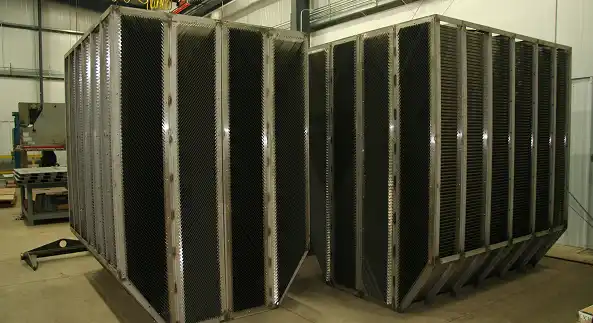
ENGINEERING PRINCIPLE
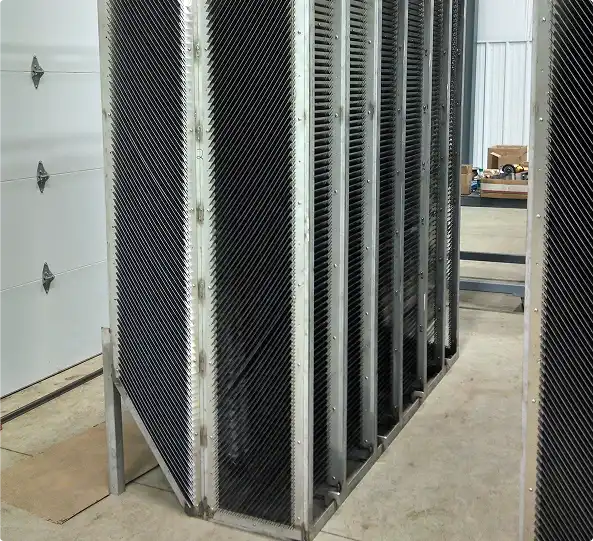
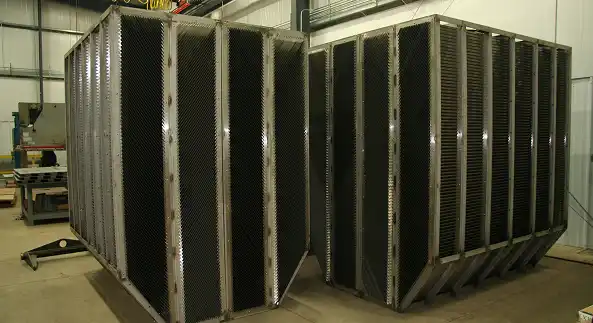
In an enhanced gravity separator, the plate pack does most of the work. Mercer’s flat-plate herring-bone design, set at a true 55° angle, is engineered around hard physics — not marketing language — to keep the flow laminar, the droplets rising, the solids falling, and the cleaning manageable.
Where other manufacturers use corrugated sheets, molded plastic blocks, or tight-geometry shapes that clog and blind, Mercer’s design uses smooth, flat, wide-open rise lanes with a herring-bone pattern that guides flow evenly across the pack. The result is a separator that behaves the same today, next week, and years from now — not only in perfect conditions.
This is not theoretical. It comes from 40+ years of field testing, system failures observed in competitive equipment, and Mercer’s commitment to building plate packs that actually last.
COMMON DESIGN FAILURES
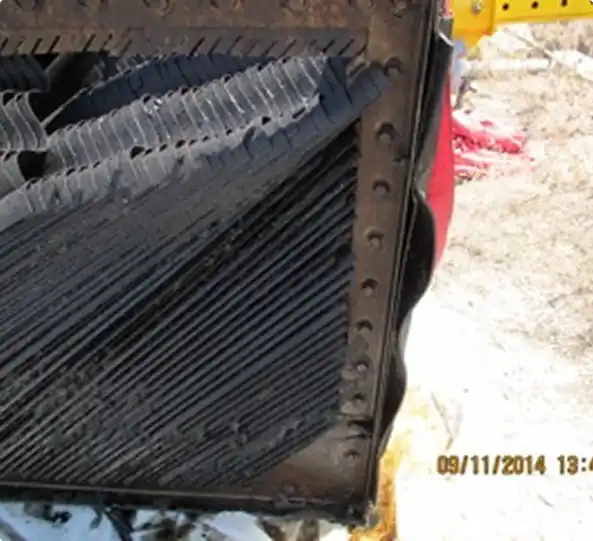
The industry is crowded with corrugated, sinusoidal, tube-style, and molded plastic packs that look efficient on paper. In reality, these designs collapse under real wastewater conditions due to:
Once the flow transitions out of laminar conditions, separation efficiency drops rapidly — and it typically happens long before anyone expects.
Mercer’s flat-plate pack avoids all of these failure modes by staying deliberately simple and physically appropriate for industrial loading.
THE ENGINEERING BEHIND IT
Here are the actual engineering reasons Mercer uses this configuration — pulled directly from the company’s long-form technical basis.
Equivalent diameter drives the Reynolds Number — and therefore the ability to stay in laminar flow.
Laminar flow isn’t a preference. It’s a requirement for gravity separation physics to work.
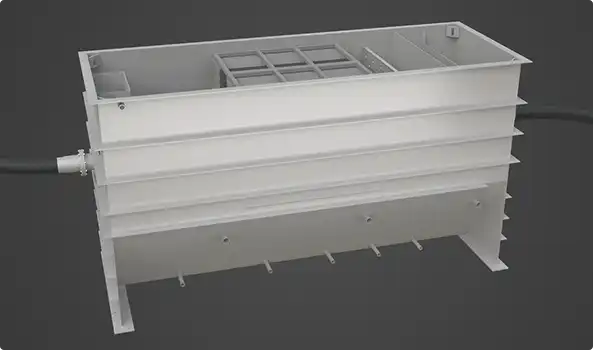
The 55° inclination is not arbitrary. It:
Mercer’s angle has decades of field validation behind it.
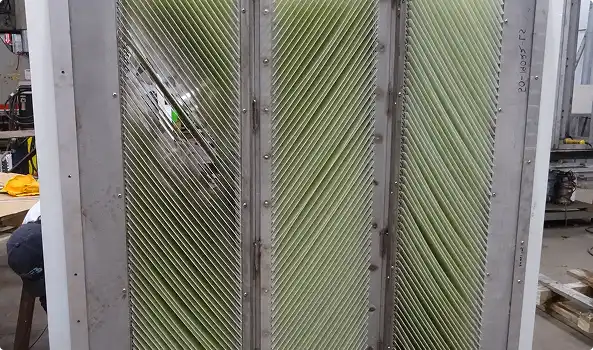
Oil droplets do not have to travel multiple feet vertically as they would in an empty tank. Mercer’s plates cut the rise distance to 24 inches or less, enabling:
This is one of the most overlooked advantages of enhanced gravity separation — but only when the plate geometry is correct.
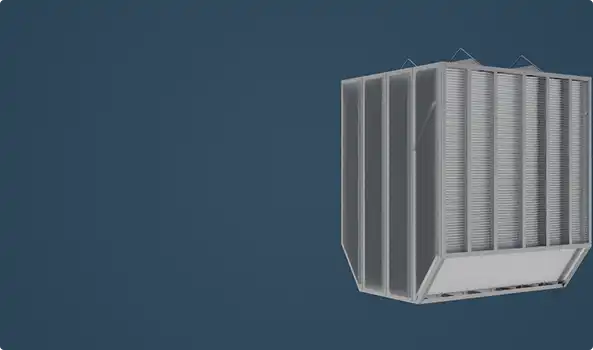
The herring-bone layout promotes even flow distribution without forcing the water into restrictive channels. It:
It’s directional, not turbulent — and fully serviceable for the life of the tank.
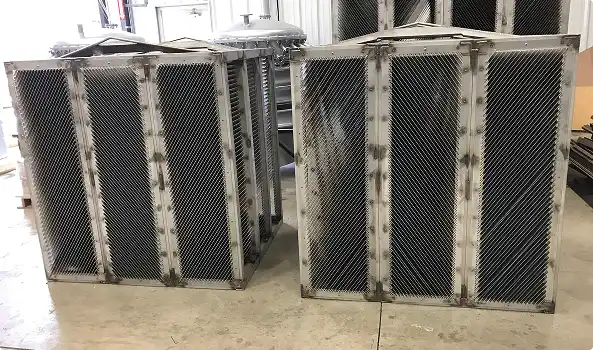
Flat plates are the only geometry that can be reliably cleaned back to factory-condition performance.
With Mercer’s plate pack:
Operators can restore the pack instead of replacing it — a major lifecycle cost advantage.
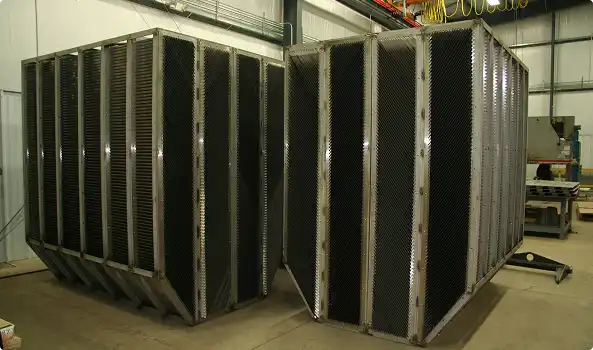
SYSTEM PERFORMANCE







FIELD RESULTS
Your influent data is reviewed, your worst-case scenario is modeled, and your wastewater is tested before a separator is ever fabricated. The results drive the design. The data drives the guarantee. No surprises after installation.
Show Me HowFlat plates maintain a large equivalent diameter, keeping the flow laminar and reducing sludge trapping — critical for industrial wastewater.
55° balances oil rise and solids fall, allowing both to move predictably without intersecting or lodging.
Typically 24 inches or less, improving separation speed and effectiveness — especially with small droplets.
Yes. The open geometry and flat surfaces shed solids naturally and resist clogging better than complex shapes.
Yes. Mercer provides free, honest testing. If the results don’t show meaningful improvement, Mercer will say so upfront.
